Freight Broker vs. 3PL vs. 4PL vs. Carrier: Who Does What in Shipping
Blog Post CTA
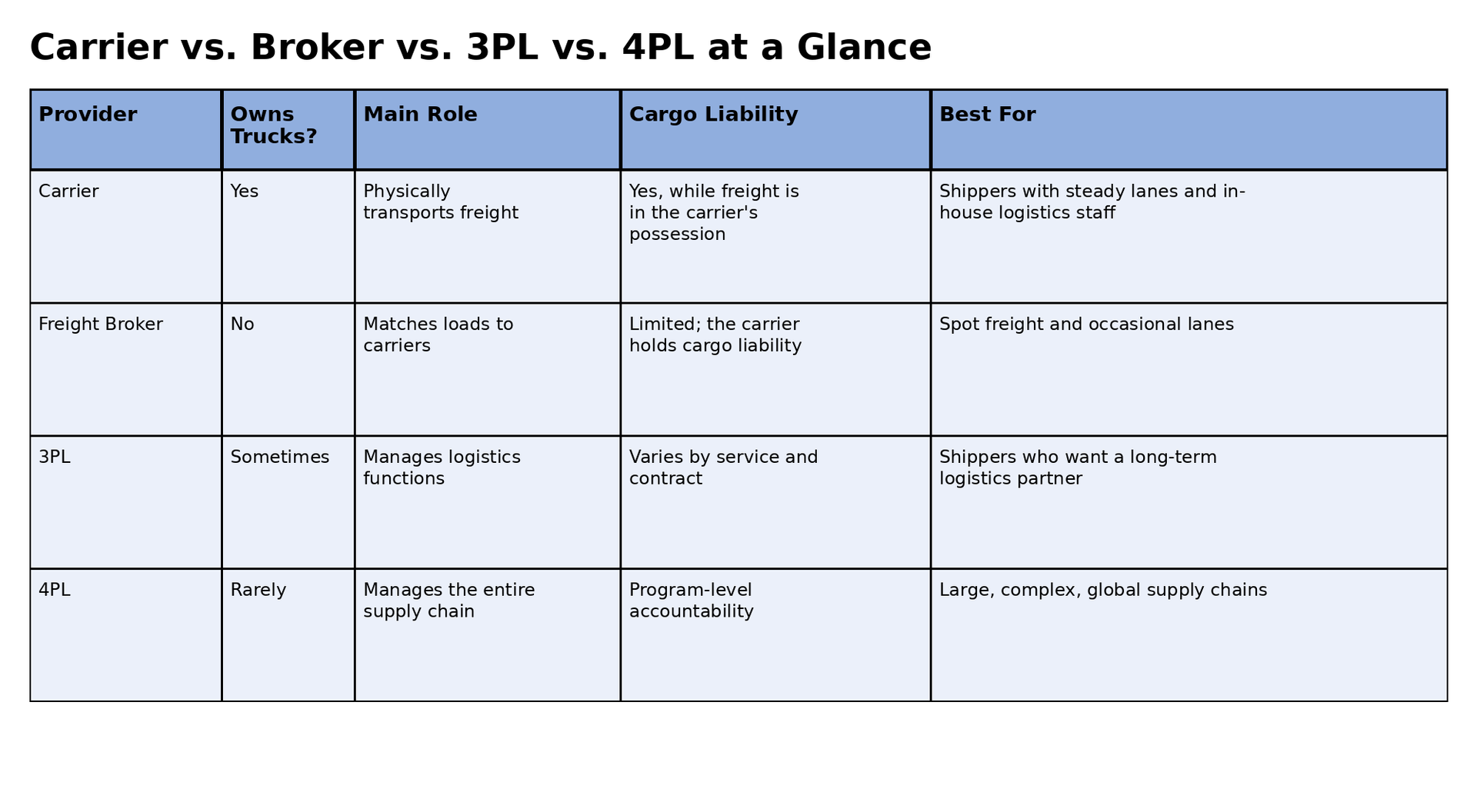
Freight broker, 3PL, 4PL, carrier: these four labels get used as if they mean the same thing. They do not. Take a freight broker and a 3PL: it is easy to confuse what each one does in the logistics process, especially when the 3PL’s main service is freight brokerage.
Yet they offer different levels of accountability for what happens to your freight after the load is booked. Choosing the wrong one often means paying for services you don’t need or missing the ones you do.
This layman’s guide lays out what each of the labels means, where the lines get fuzzy, and how to determine which model fits your shipping needs.
From First-Party Logistics to Fourth-Party Logistics: A Quick Map
The logistics industry sorts providers by how much of the job they take off the shipper’s plate. Here is how it breaks down:
- First-party logistics (1PL): The shipper moves its own goods with its own fleet, drivers, and warehouse.
- Second-party logistics (2PL): An asset-based motor carrier that owns the trucks and physically moves the freight.
- Third-party logistics (3PL): An outside provider that manages some or all of your logistics functions, often across multiple carriers.
- Fourth-party logistics (4PL): A strategic manager that oversees the entire supply chain, including your 3PLs, brokers, and carriers.
A freight broker sits alongside this ladder rather than on it. Brokers arrange transport but don’t manage the wider program, which is why the two are so often confused.
What Is a Freight Carrier?
The carrier owns or leases trucks, employs or contracts drivers, and handles the actual freight moving from origin to destination. If a driver backs into your dock and loads your pallets, that driver is either an owner-operator or an employee of a motor carrier.
Carriers range from huge fleets with thousands of trucks to owner-operators with one rig. Every motor carrier that transports freight across state lines must hold operating authority, comply with FMCSA safety regulations, and manage delays during transit.
What Does a Freight Broker Do?
A freight broker is a licensed middleman that connects shippers with motor carriers. Brokers have no trucks and no warehouses. Their value is managed access to carriers and the ability to negotiate pricing on a per-shipment basis.
In practice, the broker finds a truck, handles dispatch, and arranges pickup and delivery. Their accountability ends when the load is covered. While the freight is in transit, liability sits with the carrier, although most freight brokers also carry contingent cargo insurance as a backstop.
Brokers must hold FMCSA broker authority (an MC number) and carry a surety bond or trust fund of at least $75,000. The bond protects shippers and carriers if the broker goes out of business without paying. Brokers who arrange household goods moves need a separate registration.
What is Included in Freight Brokerage Services
Typical freight brokerage services cover:
- Sourcing and vetting carriers for each load
- Negotiating spot or contract pricing
- Booking, dispatch, and appointment scheduling
- Basic shipment tracking and delivery confirmation
- Paying the carrier and invoicing the shipper
Freight brokerage works well for spot freight, one-off lanes, or corridors you don’t ship often enough to justify a contract rate. It gives you access to capacity without adding a fleet or staff.
However, the problem with freight brokerage services is that the relationship is transactional. You get a truck for today’s load, but no one monitors your lanes over time, tracks freight costs, or catches carrier performance issues before they become patterns. Control over service is also limited. A broker may use different carriers on the same lane from week to week, which makes consistent freight transportation harder to manage.
What Is a 3PL (Third-Party Logistics)?
3PL is probably the most misused term in the freight industry. Technically, it covers any third party that handles logistics: a freight broker, a warehouse operator, a managed transportation provider, or a company that does all of that at once.
A full-service 3PL manages outsourced logistics functions as a long-term logistics partner. Services can include carrier selection, rate negotiation, shipment tracking, freight audit, reporting, warehousing, cross-docking, inventory management, fulfillment, and supply chain management consulting.
A good 3PL also works at a deeper level on your network. It can analyze your transportation network, consolidate shipments, and shift freight between modes to reduce logistics costs over time.
What Is a 4PL?
A fourth-party logistics provider manages your entire logistics network. Think of it as a layer above the 3PL. It owns supply chain planning and strategy, coordinates multiple 3PLs, brokers, and carriers on the shipper’s behalf, and is accountable for results across the whole program rather than individual shipments.
A 4PL offers a single point of contact for all supply chain operations. The model is built for large enterprises with multimodal, multi-region supply chains, including international shipments. At that size, coordinating many logistics providers in-house costs more than hiring one entity to manage them all.
Most small and midsize shippers don’t need a 4PL. If you move 20 to 50 loads a week on domestic lanes, a solid 3PL can cover everything you need.
How to Choose the Right Logistics Partner
Start with your shipping needs, not the label on a provider’s website. These questions help:
- How many loads do you move each week, and how predictable are your lanes?
- Do you need warehousing, inventory management, fulfillment, or only transportation services?
- Who on your team has time for carrier coordination, tracking, and freight audits?
- Do you want reporting on freight costs and carrier performance, or just coverage?
Also ask what add-ons cost. Some providers quote low per-load pricing, then charge extra for tracking, reporting, or accessorial management.
Finally, ask for references from customers who ship similar freight. Logistics experts who can show you real performance data for customers like you are far easier to trust than a list of services on a homepage.
The EFS Model
Entourage Freight Solutions is a 3PL with the carrier network and operational depth that the label implies. EFS has access to over 4,500 dry freight carriers and over 3,500 prequalified reefer carriers, and manages the full cycle from carrier match through delivery with cradle-to-grave tracking and 24/7 operations staffing.
The difference between that and a broker is the difference between covering a load and managing a freight program. Contact us today to get started.
Frequently Asked Questions
Is a freight broker a 3PL?
Technically, yes. A freight broker is a type of third-party logistics provider. But most freight brokers only arrange transportation, while a full-service 3PL also manages warehousing, reporting, and ongoing supply chain management.
Who is liable if freight is damaged, the broker or the carrier?
In most cases, the carrier is liable for cargo while it is in its possession. Brokers generally aren’t liable for cargo loss, though many carry contingent cargo insurance. Review your contract for the specific terms.
Do I need a 4PL?
Probably not, unless you run a large, multi-region supply chain with several logistics providers to coordinate. Most small and midsize shippers get what they need from a strong 3PL.
What is the difference between a freight broker and a freight forwarder?
A broker arranges transport between shippers and carriers without taking possession of the freight. A freight forwarder often consolidates shipments, issues its own bill of lading, and is common in international shipping.